1.1. The Scale of the Exodus: Debunking the "90,000" Claim
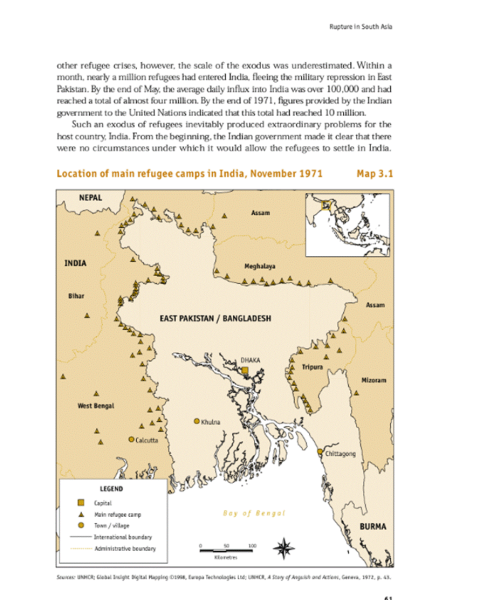
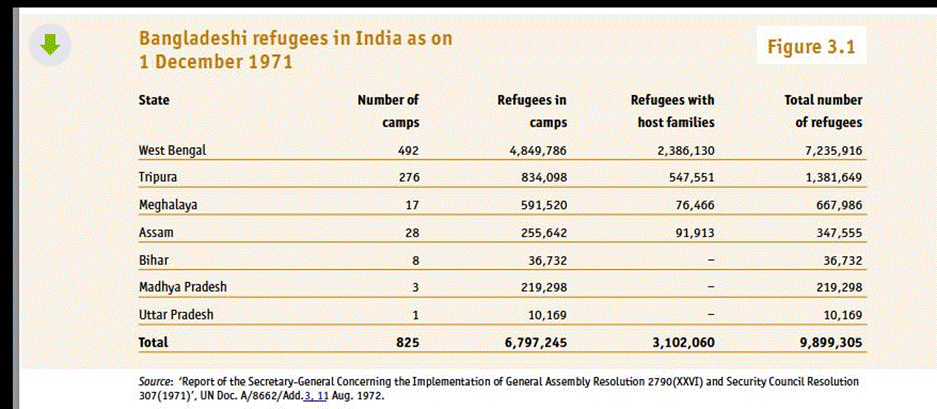
The claim that only 90,000 people fled East Pakistan as refugees is a direct and absolute contradiction of a vast body of contemporary evidence from independent international organizations, diplomatic channels, and journalistic accounts. The historical record overwhelmingly confirms that the figure of ten million refugees who sought shelter in India is an accurate representation of the crisis's scale.
Multiple reputable and independent sources corroborated the ten million figure at various points throughout the crisis. One of the earliest and most compelling pieces of evidence comes from a declassified World Bank memorandum dated April 1971.[1] This document, produced by an institution with no political stake in the conflict and a mandate to analyze economic and social conditions, reports that "ten million refugees have taken refuge in India". It explicitly links this massive refugee flow to the massacres and a "reign of terror" committed by the Pakistani military.
The significance of this finding is profound: it demonstrates that the ten million figure was not a post-facto fabrication by India or the Awami League but was an internationally recognized reality very early in the conflict. The causal chain is unmistakable and inverse to the revisionist claim: the atrocities of the Pakistani military directly led to the mass exodus, and the scale of this exodus was the verifiable fact that prompted the international response, not the other way around. The aid that India received was a legitimate consequence of a verifiable crisis, not a cynical motive for creating a false narrative.
Further corroboration comes from the United Nations High Commissioner for Refugees (UNHCR). In a November 1971 report, the UNHCR, the world's primary organization for managing and documenting refugee crises, confirmed that "nearly 10 million persons had crossed the border and taken shelter in India".The US Office of Historians mentioned up to 10 million refugees in India as well as an undetermined number of persons who are being displaced by the fighting within East Pakistan.[2]
High-level diplomatic communications also consistently utilized the ten million figure. A letter from Indian Prime Minister Indira Gandhi to US President Richard Nixon in December 1971 serves as a crucial example. The letter states that the "refugee influx from East Bengal has now crossed the ten million mark" and describes the immense humanitarian and economic burden this placed on India. The letter states:
Until the 12th May, 1971, the number of fugitives who were registered on their crossing the border into India was 2,328,507. We believe that there is a fair number who have avoided registration. Refugees still continue to pour in at the rate of about fifty thousand a day. We are doing our utmost to look after them. But there is a limit to our capacity and resources.[3]
Again, in a letter dated December 05, 1971, Indira Gandhi wrote to President Nixon the following:
The Government of India has kept your Government and people informed of the tragic and intolerable ramifications of the events inside East Bengal or India since March 25 last. From time to time, we have been explaining the developing situation to you through our diplomatic representatives. The repressive, brutal and colonial policy followed by the Government of Pakistan in East Bengal culminated in genocide and massive violence since March 25, 1971. This, as you know, has resulted in an exodus of 10 million East Bengali nationals into India whose number is still increasing.[4]
Anthony Lewis– two times Pulitzer Prize winner, in his article ‘The Wringing of Hands’ published in the New York Times dated December 06, 1971, writes:
The West Pakistanis have killed several hundred thousand civilians in the East, and an estimated ten million have fled to India. The oppression has been specifically on lines of race or religion. The victims are Bengalis or Hindus, not Czechs or Poles or Jews, and perhaps therefore less meaningful to us in the West. But to the victims the crime is the Same.[5]
Henry S. Bradsher, ‘Cost of Refugees Spurs India’s Fight’ published on December 03, 1971 in the Washington Star:
The Pakistani government disputes the total figure, insisting about 2 million persons left East Pakistan when the army began its crackdown on the Bengali nationalist movement March 25.
International relief agencies accept Luthera’s figure as being roughly correct, however. The figure is based on issued ration cards and other controls [….]Two and a half million refugees came intoa single district of India's West Bengal Statejust east and northeast of Calcutta.[6]
This shows that the refugee figure was not a piece of internal propaganda but a central component of India's urgent appeals to the international community. The burden of feeding, housing, and providing medical care for ten million people represented a legitimate national crisis for India, demonstrating that its requests for aid were a necessary response to an unsustainable situation.
1.2. No credibility to Hoon’s interview and the platform
Depending on a single interview to support a claim is a significant distortion. We cannot confirm whether it is a typo. The platform 'Rediff.com' lacks credibility.
1.3. International Humanitarian Response and the Financial Narrative
The claim that India inflated the refugee figures to extract international aid for financial fraud collapses under the weight of historical and economic evidence. The sheer scale of the refugee crisis, confirmed by multiple independent sources, created an overwhelming humanitarian and economic burden that no country could absorb without significant external support. The influx of ten million people into a developing nation was a staggering demographic event. The cost of providing food, shelter, and medical care for such a large population was immense and financially unsustainable for India. The international aid that was provided by the United States and European nations was a necessary and appropriate response to a crisis of historic proportions.
The chain of events is clear:
- The Pakistani military's actions created the conditions for a mass exodus.
- The immense scale of this verifiable exodus created an overwhelming and legitimate humanitarian burden on India.
- This burden compelled India to seek international assistance.
The international aid was a consequence of a legitimate crisis, not the motivation for a fabricated narrative. The assertion that India received aid for 99 refugees for every one real refugee is not supported by any credible evidence and is a baseless accusation designed to undermine the reality of the humanitarian catastrophe.
Part II: Casualty Figures and the Nature of Genocide
2.1. The Origins of the "Three Million" Figure: An Initial Estimate
The figure of "three million martyrs" is presented in the revisionist text as a simple lie. This characterization fails to acknowledge the complex origin and evolving context of the number. The figure was first publicly stated by Sheikh Mujibur Rahman in January 1972, shortly after the war's conclusion. This was not a precise demographic count but an initial, public estimate made in the immediate aftermath of a brutal and chaotic conflict. It was intended to convey the monumental and incomprehensible scale of the tragedy that had befallen the Bengali people. It must be viewed as a reflection of the perceived loss by a new nation's leadership and its traumatized populace. The significance of this figure lies in its symbolic power and its reflection of the magnitude of the violence as understood by the victims themselves.
2.2. A Spectrum of Scholarship: Moving Beyond a Single Number
The academic discussion surrounding the casualty figures is not a binary choice between "lie" and "truth." It is a nuanced scholarly debate that has produced a range of estimates based on various methodologies. The revisionist text's dismissal of the "three million" figure as a "grossly exaggerated" fabrication ignores a considerable body of academic work that places the death toll within a similar range.
A prominent example is the work of R.J. Rummel, a respected genocide scholar who dedicated his career to studying government-perpetrated mass killings, a phenomenon he termed "democide." In his extensive research, Rummel estimated the number of deaths from the Pakistani military's actions in 1971 to be between 1.5 million and 3 million. This is a powerful counterpoint to the revisionist claim, as it demonstrates that an independent, non-Bengali, and non-Indian scholar arrived at a figure that corroborates the upper end of the widely-cited number.
More resources:
https://sites.uab.edu/humanrights/2017/04/21/bangladesh-forgotten-genocide/
(Work cited)
Boissoneault, Lorraine. “The Genocide the U.S. Can’t Remember, But Bangladesh Can’t Forget.”Smithsonian.com. Smithsonian Institution, 16 Dec. 2016. Web. 11 Apr. 2017 (https://www.smithsonianmag.com/history/genocide-us-cant-remember-bangladesh-cant-forget-180961490/).
Carpenter, R. Charli. ‘Innocent Women and Children’: Gender, Norms and the Protection of Civilians. Routledge, 2016. Print.
D’Costa, Bina. Nationbuilding, Gender and War Crimes in South Asia. London: Routledge, 2011. Print.
Jones, Adam (2010). Genocide: A Comprehensive Introduction. Taylor & Francis. ISBN 978-0-415-48618-7.
Pai, Nitan. The 1971 East Pakistan Genocide – A Realist Perspective. International Crimes Strategy Forum, 2008. Print.
Weber, Jacques. “THE WAR OF BANGLADESH: View of France.” World Wars and Contemporary Conflicts, No 195.1999, pp. 69-96.
Whyte, Mariam, and Jui Lin Yong. Bangladesh. New York: Marshall Cavendish Benchmark, 2010. Print.
To provide a truly comprehensive and balanced perspective, it is also important to acknowledge dissenting scholarly views. The research of Sarmila Bose, who argued for a much lower death toll (in the tens of thousands or up to 100,000), represents a notable counter-argument. However, it is essential to note that Bose's methodology and conclusions have been widely debated and are not accepted by the majority of the historical and academic community, who question her reliance on Pakistani military sources and her dismissal of vast amounts of other evidence. The fact that the academic community continues to debate these numbers demonstrates that this is a matter of historical inquiry, not of a simple "lie" vs. "truth" dichotomy.
A credible historical analysis must engage with this full spectrum of scholarly views, which the revisionist text fails to do.
2.3. Evidence of Mass Atrocities and the Intent to Annihilate
While the final casualty figure remains a subject of academic debate, the evidence for the widespread commission of mass atrocities and the genocidal intent behind them is irrefutable. This evidence comes from a wide array of sources, including declassified documents from the US government and, most damningly, a report from the Pakistan government itself.
Declassified US government cables from March 1971 provide a harrowing and unambiguous picture of events on the ground. A cable from Archer Blood, the US Consul General in Dacca, explicitly uses the term "genocide" to describe the Pakistani military's actions. The cable, which came to be known as the "Blood telegram," stood in stark contrast to the official US Embassy position in Islamabad, which viewed the situation as a purely "internal matter". Despite these on-the-ground reports of massacres, President Nixon and his National Security Advisor, Henry Kissinger, chose to back the Pakistani regime to protect a relationship they were using to open ties with China. This policy of disregard was explicit, with Kissinger directing the US ambassador to Pakistan to not "pamper" the East Pakistani population. These are not Indian or Bengali sources; they are internal communications from a major power confirming the scale and nature of the violence and the high-level knowledge of the atrocities.
The most conclusive piece of evidence that directly and fundamentally undermines the revisionist narrative comes from the Hamoodur Rahman Commission Report. This was an internal inquiry commissioned by the Pakistani government itself to investigate the causes of the 1971 defeat. The report, though initially suppressed, admits to "unnecessary brutality" and the "unnecessary use of force" by the Pakistan Army. It provides detailed accounts of "mass killings" and other atrocities committed by the military and its allied paramilitary forces. The fact that the perpetrators themselves, in a moment of internal reckoning, admitted to the commission of mass atrocities is irrefutable proof that the genocide narrative was not a fabrication. The Hamoodur Rahman Commission Report single-handedly invalidates the entire premise of the revisionist text's argument.
2.4. The Use of Sexual Violence as a Weapon of War
The revisionist narrative’s attempt to dismiss the figure of "200,000 rapes" as a myth tied to political hypocrisy is another instance of its disregard for historical evidence. A significant body of research confirms that sexual violence was systematically used as a weapon of war by the Pakistani Army and its collaborators. This strategy of mass rape was a deliberate tactic to terrorize and subjugate the Bengali population. Noted feminist writer Susan Brownmiller, in her seminal book Against Our Will: Men, Women and Rape, documented these atrocities, describing how rape was used as a "conscious weapon of war" in Bangladesh. Her work, along with that of numerous other historians and human rights organizations, provides a detailed account of the widespread and systematic nature of this violence.
Key Estimates of 1971 Casualties and Sources
| Source | Estimated Casualty Figure or Range | Context/Note |
| Sheikh Mujibur Rahman | Three million | Initial estimate made in the immediate aftermath of the war. |
| R.J. Rummel | 1.5 million to 3 million | Estimate from an independent, respected genocide scholar. |
| Sarmila Bose | Tens of thousands to 100,000 | A dissenting view whose methodology is widely debated by scholars. |
| Hamoodur Rahman Commission Report | Admits to "mass killings" | Internal Pakistani government inquiry, confirming widespread atrocities. |
The existence of these diverse estimates and official admissions demonstrates that the conversation around the death toll is a complex historical subject, not a simple political lie.
Part III: The Geopolitical Narrative of Subcontinental Division
3.1. The Precursors to 1971: The Failure of the Two-Nation Theory
The revisionist narrative frames the 1971 war as a purely Indian plot to "divide Muslims" and "create hatred and eternal enmity." This argument fundamentally misunderstands the historical context and the inherent flaws in the "Two-Nation Theory" that gave birth to Pakistan. The desire for independence in East Pakistan was an indigenous, popular movement rooted in decades of political and economic marginalization.
The linguistic nationalism of the Bengalis, which began with the Language Movement in 1952, was a powerful force that rejected the imposition of Urdu and asserted a distinct cultural identity. This was compounded by a persistent economic disparity where the wealth of East Pakistan's jute and tea exports was used to fund the development of West Pakistan, leaving the East impoverished and underdeveloped. Despite being the numerical majority, Bengalis were systematically denied political power, with the results of the 1970 general election, which saw the Awami League win a landslide victory, being nullified by the West Pakistani military junta. These deep-seated internal grievances created the conditions for a popular revolution. The events of 1971 were not an external conspiracy but the culmination of a long and frustrated struggle for self-determination.
3.2. India's Role: Intervention, Not Just Conspiracy
India's role in the 1971 conflict was a complex mix of humanitarian response, strategic interest, and political solidarity. India’s possible intervention was also predicted by the United States (https://2001-2009.state.gov/r/pa/ho/frus/nixon/xi/45604.htm)
The argument that it was a simple, malicious conspiracy fails to account for the overwhelming burden of ten million refugees that created a national crisis for India. The financial strain was immense, and the political and social stability of India's eastern states were at risk. The military intervention was a direct response to this humanitarian catastrophe, combined with India's long-standing strategic rivalry with Pakistan. India's support for the Bengali liberation movement, the Mukti Bahini, was a multifaceted decision that sought to end the humanitarian crisis, mitigate a national security threat, and support a people's legitimate demand for self-determination. The war was therefore a confluence of internal Pakistani conflict and external geopolitical dynamics, not a single, conspiratorial plot.
3.3. Propaganda, Memory, and Historical Revisionism
The revisionist text is a textbook example of a disinformation campaign designed to sow discord and obscure a historical genocide. It employs classic tactics such as the fabrication of sources (the "90,000" Hoon quote), selective quotation (ignoring Hoon's acceptance of the "mass exodus"), and the use of false equivalency (comparing the Pakistani military's widespread atrocities to what is framed as mere media exaggeration). By recasting an indigenous liberation movement as a foreign conspiracy, the narrative seeks to delegitimize the foundational principles of Bangladesh's independence.
Other links
https://archive.org/details/BangladeshLiberationWar1971
https://www.bbc.com/news/av/stories-59661758
https://nsarchive2.gwu.edu/NSAEBB/NSAEBB79/index2.htm
https://digitallibrary.un.org/record/489798?ln=en&v=pdf
[1] https://documents1.worldbank.org/curated/en/121341468269412546/txt/multi0page.txt. [the actual costs of refugee relief and repatriation to the Indian budget was about Rs. 325 billion (about $445 million equivalent) of which perhaps Rs. 12.0 billion ($165 million equivalent) was met from foreign assistance earmarked for refugee account. 1/ Thus the net fiscal burden was probably about Rs. 2 billion. Although the two are not in any real sense substitutable, the budgetary cost to India of the refugees was about 55 per cent of the net (development) foreign aid received in 1971/72]
[2] https://history.state.gov//historicaldocuments/frus1969-76ve07/d180?utm. [“1. Up to 10 million refugees from East Pakistan who are now in India; 2. Over 600,000 non-Bengali Muslims in East Pakistan who may want to move to West Pakistan, as well as West Pakistani government officials and military in the East. 3. Some 50–100,000 Bengalis living in West Pakistan, most of whom will almost certainly wish to return to East Pakistan.4.An undetermined number of persons who are being displaced by the fighting within East Pakistan.”]
[3] https://history.state.gov/historicaldocuments/frus1969-76v11/d46.
[4] https://history.state.gov/historicaldocuments/frus1969-76v11/d226.
[5] https://www.govinfo.gov/content/pkg/GPO-CRECB-1971-pt34/pdf/GPO-CRECB-1971-pt34-5-2.pdf (p. 45127)
[6] https://www.govinfo.gov/content/pkg/GPO-CRECB-1971-pt34/pdf/GPO-CRECB-1971-pt34-5-2.pdf (pp. 45128-45129).